
What Is the Extracellular Matrix of Connective Tissue Composed Of?
Learn what extracellular matrix is, how it works, and why it matters in tissue structure and healing. A clear, easy explanation for beginners.

The supportive structure of the human body is composed of connective tissues. They anchor, shield, and support organs, bones, and muscles, while keeping our systems strong. Central to this collection of tissues is a dynamic and important network identified as the ECM. This matrix is more than a substance filling the spaces between cells; it is an interactive habitat that interacts with cells, directs their growth, and supports healing.
The Foundation of Connective Tissue
Fibrous connective tissue, a structural protein-based tissue, is the most common type of connective tissue found in animals. It makes up about 30% of the human body and includes both loose and dense connective tissues. This tissue is composed of cells, primarily fibroblasts and macrophages and an extracellular matrix rich in collagen fibers with minimal ground substance. Cells responsible for forming and maintaining this extracellular matrix include fibroblasts, osteoblasts, and chondrocytes.
A study published on 22 July 2019 show,The u of connective tissues depends on the physical and biochemical properties of their extracellular matrix (ECM), which are in turn dictated by ECM protein composition. With the primary objective of obtaining quantitative estimates for absolute and relative amounts of ECM proteins, we performed a systematic review of papers reporting protein composition of human connective tissues.
Depending on how these fibers and ground substance are organized, the ECM can make tissues soft or elastic like cartilage, or hard and dense like bone. This flexibility enables connective tissue to serve a wide variety of purposes, from cushioning between organs to structuring the hard framework of our skeletons.
Main Components of the Matrix
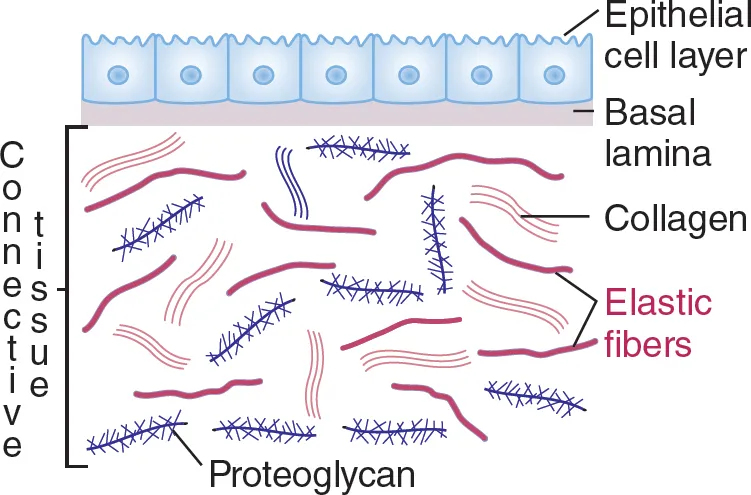
Connective tissue extracellular matrix consists of both fibers and ground substance, the two of which cooperate to provide a supportive and protective environment for cells.
Fibers
There are three major types of fibers within the ECM: Elastic
- Fibroollagenous: Tensile strength and not stretch resistant.
- Fibers: Let tissues, such as skin and lungs, expand or return to their original shape.
- Reticular fibres: Fine supportive networks for soft organs, e.g., liver and lymph nodes.
Ground Substance
This jelly-like substance is what fills the gaps between fibers and cells. It consists of:
- Proteoglycans: Molecules that hold water and are resistant to compression.
- Glycoproteins: Including fibronectin and laminin, which aid in cell attachment to the matrix.
- Water and ions: These are also important for nutrients and waste to exchange between cells.
Between them, they provide the ECM with its integrity, elasticity and rebound.
What Is An Extracellular Matrix?
The extracellular matrix is a 3D structure that surrounds cells and supplies mechanical as well as biochemical support. It consists predominantly of proteins, carbohydrates and water.
Far from being a passive context, the ECM dynamically informs how cells act, migrate and receive signals. It is the physical environment for cells to attach, grow and function and houses important molecules such as growth factors that control development and healing. ECM-based materials are used to mimic the body's natural environment, leading to groundbreaking clinical applications in wound healing.
Structural Organization of the Matrix
The structure of the ECM is different for each type of connective tissue. For instance, bone is a calcified matrix that contains a large amount of calcium phosphate, allowing for its hardness and resistance to breakage. Cartilage, meanwhile, is rich in proteoglycans that render it flexible and pressure-resistant.
Despite these variations, all matrices follow the same general rule: fibers for strength and ground substance for flexibility, which enables tissues to fulfill their specific functions with proficiency.
Biological Significance of the Extracellular Matrix
The ECM is not simply a scaffold, but rather a biologically active system that directs fundamental cell processes. It makes cells stick to surfaces, it directs tissue growth and delivers chemical messages.
Some major roles include:
- Supporting cell attachment and shape
- Controlling cell migration during wound healing
- Regulating growth and differentiation
- It functions as a storage site for the signaling molecules.
Proper ECM function is important for tissue integrity and healing after injury.
What Is Extracellular Matrix in Connective Tissue Made Of?
In connective tissue, the extracellular matrix is made up of collagen, elastin, proteoglycans, glycoproteins, and water. All of these aspects serve an important function:
- Collagen provides the tissue with strength and form.
- Elastin provides flexibility and resilience.
- Proteoglycans bind water, which helps to hydrate the tissue.
- Glycoproteins provide some linkage between cells and their matrix.
- Water helps to hydrate cells and distribute nutrients.
This substance mix is what makes each connective tissue feel the way it does, hard in bone, stretchy in ligaments, squishy in skin.
Interaction Between Cells and the Matrix
Cells are always talking to the ECM through special receptors called integrins. These receptors connect the cell’s inner structure to the outside matrix, and bidirectional signaling is possible. Further studies show that each component of the linkage from the cytoskeleton through the integrin-mediated adhesions to the extracellular matrix therefore transmits forces that may derive from both intracellular, myosin-generated contractile forces and forces from outside the cell. These forces activate a wide range of signaling pathways and genetic programs to control cell survival, fate, and behavior. This flow of information is what controls the behavior, migration and survival of the cells.
This interaction, referred to as cell-matrix signaling, is central for tissue formation during development, wound repair and regeneration. It allows cells to feel their environment and respond accordingly.
Renewal and Remodeling of the Extracellular Matrix
ECM is dynamically reborn and restructured during lifetime. Old or damaged matrix components are degraded by enzymes, such as matrix metalloproteinases (MMPs), and new ones are synthesized by cells to balance this state. This study also supports this statement, the role of MMPs in normal wound repair as well as in chronic ulcers, is discussed. In addition, the role of signaling pathways, in particular, mitogen-activated protein kinases (MAPKs) in regulating MMP expression, is discussed as a possible therapeutic targets for wound healing disorders.
That process is not only important for the sake of healthy, functioning tissues. For instance, ECM remodeling in the course of wound healing enables immune cells to arrive at the site of injury and contributes to new tissue formation. “Balanced” remodeling helps to maintain strong, flexible tissues.
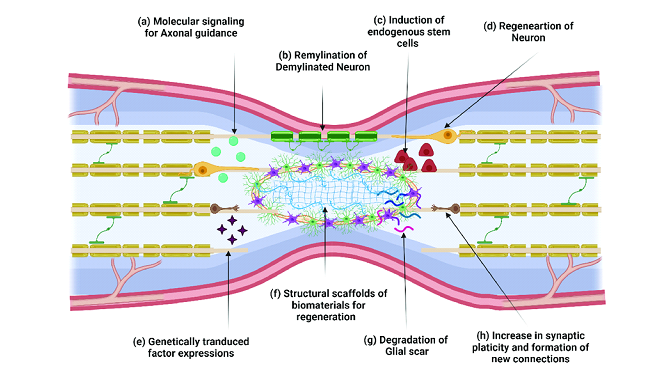
What Is Extracellular Matrix and Its Role in Medicine
The definition of what is extracellular matrix is has now become the basis of modern regenerative medicine. ECM-based materials are used by engineers for the support of healing and tissue growth as they themselves mimic the body's natural environment.
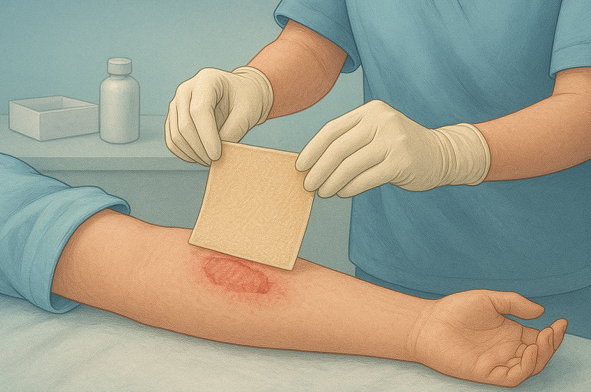
In wounds, ECM dressings made from animal or synthetic material help to direct new cell growth and speed recovery. decellularized ECM scaffolds are also employed in tissue engineering to restore organs, for example, the heart, skin, and cartilage. These developments that emerged illustrate the fundamental role of ECM technologies in today's healthcare.
Variety of ECM in Different Connective Tissues
Each type of connective tissue has its own specific extracellular matrix (ECM), reflecting its unique need to maintain connectivity, provide support, and enable growth.
- Loose Connective Tissue: Soft, pliable tissue that cushions and protects the body's delicate organs.
- Dense regular connective tissue: Contains abundant collagen fibers that give rise to tendons and ligaments.
- Cartilage: Rich in proteoglycans, which provide the cartilage with the ability for resilience and cushioning.
- Bone: The mineralised ECM offers physical support and immune protection.
- Blood: Its ECM is a plasmic fluid carrying nutrients and waste.
This variety serves as a response of the body to different mechanical and physiological needs.
Frequently Asked Questions:
1. What Is Extracellular Matrix Connective Tissue Made Of?
It contains fibrous proteins (collagen, elastin, and reticular fibers) and a ground substance consisting of proteoglycans and glycoproteins in addition to water. The two of these form a supportive structure for cells.
2. What Is the Basic Composition of the Extracellular Matrix?
The core substance is made up of collagen and elastin fibers, adhesive glycoproteins (e.g., fibronectin, laminin), and hydrated ground substances containing high amounts of glycosaminoglycans.
3. What Are the Three Components of the Extracellular Matrix?
The three primary components are
- Fibers.
- Ground substance.
- Cells of matrix deposition and remodelling.
4. What Are the Main Types of Extracellular Matrix?
There are two main types:
- Basement membrane (basal lamina): Layer of ECM that underlies epithelial cells.
- Interstitial matrix: substance that occupies the spaces between tissues through which it moves.
5. What are the two major components of a matrix?
The two most important components are fibres and ground substance, which determine the strength and flexibility (and function) of connective tissues.
Conclusion
The extracellular matrix (ECM) of connective tissues is a dynamic and diverse network that interacts with neighboring cells on physical, nutritional, and signaling levels. It consists of fibers, ground substance, and cells, each contributing collectively to the structure and function of the tissue.
An extracellular matrix reveals how vital it is for tissue repair, growth, and regeneration. From providing strength to bones to enabling flexibility in skin and tendons, the ECM remains one of the body’s most remarkable biological systems. Its study continues to inspire breakthroughs in regenerative medicine, wound care, and tissue engineering, shaping the future of healthcare and healing.


More from KessGen Insights.
.webp)

.webp)
To unlock the full power of the ECM and pioneer a new era of regeneration.


.webp)
.png)
.webp)

.png)