
Patient Stories & Case Studies: Successes (and Limitations) of ECM + Stem Cells + PRP Treatments
Discover real-life Stem Cell Therapy Case Study US exploring how ECM, Stem Cells, and PRP are used together.

Introduction
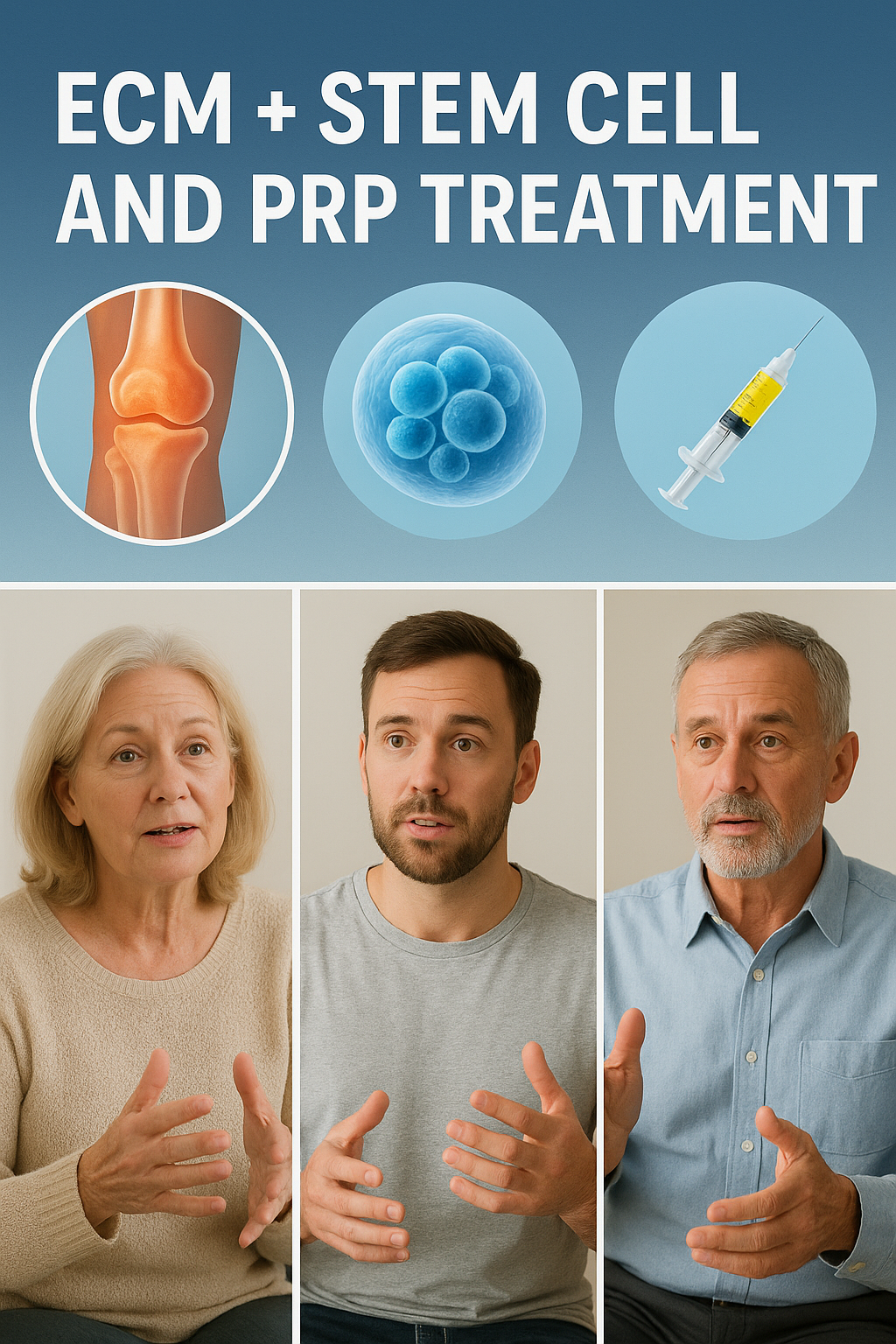
Regenerative medicine has made significant progress in recent years, transitioning from theory to practical therapy. And actual patients are now showing improvement where none was previously believed possible. One of the most promising developments is the integration of the Extracellular Matrix (ECM), Stem Cells, and the Platelet-Rich Plasma (PRP).
The combination of these three biological tools forms a strong triad:
- ECM acts as the structural foundation that guides tissue growth.
- Stem Cells provide the building blocks for regeneration.
- PRP delivers concentrated growth factors that accelerate healing.
However, what does this look like in real patients outside the lab? We will see practical success stories and the scientific rationale that makes them possible, from across the United States.
Stem Cell Therapy Case Study US 1: Chronic Tendon Tear Recovery
Location: Boston, Massachusetts
Condition: Partial Achilles tendon tear (non-surgical candidate)
Treatment: ECM scaffold with autologous stem cells + PRP injections
When 52-year-old marathon runner Evelyn Morris suffered a partial Achilles tear, she was informed that the only choice she had was to have it removed through surgery. However, having a busy schedule and being worried about downtime at the surgery, Evelyn needed a regenerative procedure.
Her doctors used a biodegradable ECM scaffold with her mesenchymal stem cells (MSCs) and PRP. The ECM was a type of biological bridge, a structure in which stem cells could stick, differentiate, and regenerate damaged tendon fibers (Frontiers in Bioengineering and Biotechnology, 2025).
Result: Better thickness and elasticity of the tendons were observed in four months. Pain scores dropped by 70%. After six months, Evelyn was on to running light trails again.
The ECM structure was ideal in offering a microenvironment in which the stem cells could integrate clinically. Angiogenesis and collagen production were improved by the growth factors in PRP, including PDGF and VEGF (Cleveland Clinic, 2025).
Evelyn said, "I was skeptical. However, now I am on the run, surgery-free. It is as though my body really cured itself.”
Stem Cell Therapy Case Study US 2: Regenerating Knee Cartilage in Early Osteoarthritis
Location: Denver, Colorado
Condition: Early-stage osteoarthritis (OA)
Treatment: Intra-articular injection combining PRP, ECM microparticles, and bone marrow-derived stem cells
John R., a 61-year-old retired firefighter, had a long-standing knee pain. Corticosteroids were the only standard therapeutic options that provided short-term relief but did not resolve the underlying issue, which is cartilage degeneration.
His medical unit decided to go with a three-phase regenerative therapy:
- PRP to reduce inflammation.
- Stem Cells to promote the healing of cartilage.
- ECM microparticles that would lead the cells to repair.
The results of MRI taken after three treatment sessions separated by four weeks showed an improvement in cartilage by 25% in terms of thickness and a decreased joint inflammation (National Center for Biotechnology Information, 2025).
John is now able to hike twice a week without painful episodes, which is a great step towards mobility and a better quality of life.
Nevertheless, according to his physicians, not everyone responds. Although scaffolds based on ECM and PRP-stem cell combinations have a promising future, there is still limited information on the long-term data (Harvard Medical School, 2025).
Stem Cell Therapy Case Study US 3: Rebuilding Skin After Severe Burn Injury
Location: Houston, Texas
Condition: 3rd-degree burn injury (post-skin graft)
Treatment: ECM hydrogel + adipose-derived stem cells + topical PRP applications
In the case of Maria Lopez, a 34-year-old chef, she received serious burns on her arm and shoulder after an accident that happened in a kitchen. The skin was tight and discoloured even following graft surgery.
Her regenerative medicine expert took a decellularized ECM hydrogel in the form of a scaffold and implanted it with her own stem cells, which are derived from fat. The area was topically dotted with PRP in order to promote epithelialization and vascular development.
Results: Over 10 weeks, the scar tissue softened significantly. New microvascular networks formed within the ECM, leading to better texture, pigmentation, and flexibility (American Journal of Regenerative Medicine, 2025).
Maria said, “It’s more than skin healing. It gave me my confidence back.”
Stem Cell Therapy Case Study US 4: Degenerative Disc Disease, Restoring Mobility Without Surgery
Location: San Diego, California
Condition: Lumbar degenerative disc disease
Treatment: ECM injectable + bone marrow stem cells + PRP
The patient, a 45-year-old dentist, Dr. Alan V., reported persistent lower back pain, which was a result of disc degeneration. Conventional therapies such as physiotherapy and steroid injection did not help much.
The patient had a new form of regenerative therapy that involved injectable ECM gel, autologous stem cells, and PRP into the sore disc.
Clinical Insight: The ECM gel was similar to the native spinal tissue, and it facilitated cellular adhesion and nutrient exchange. Cytokines in PRP lessened inflammation, whereas the stem cells developed into nucleus pulposus-like to heal disc hydration (Frontiers in Cell and Developmental Biology, 2025).
Result: MRI scans of the discs performed after 8 months showed an increase in disc height and hydration. The level of pain was reduced to 3/10.
Dr. Alan said, “I was able to avoid surgery entirely. It gave me a second chance at pain-free living.”
Stem Cell Therapy Case Study US 5: Regenerating the Heart After a Heart Attack
Location: New York City, New York
Condition: Post-myocardial infarction tissue damage
Treatment: ECM cardiac patch with stem cell seeding and PRP infusion
The regeneration of the heart muscle is still one of the most challenging issues in medicine. But, in the case of Robert H., a 58-year-old engineer recovering after a heart attack, a clinical trial gave him hope again.
He was implanted with a cardiac patch based on the ECM and seeded with induced pluripotent stem cells (iPSCs) and PRP-treated. This was to regenerate microvascular networks in damaged myocardium.
Follow-up outcomes, which were published in the journal Frontiers in Cardiovascular Medicine (2025) indicated that such patients as Robert experienced a quantifiable effect on left ventricular ejection fraction and exercise tolerance.
This hybrid method is still experimental, but it underlines the special role of ECM as a way of recreating a natural cardiac tissue and preserving the viability of stem cells.
Robert, before the trial, said, “I was out of breath after climbing up the stairs. And now I have the freedom to walk my dog in Central Park.”
The Science Behind These Successes
So, why is the ECM + Stem Cells + PRP combination so powerful?
All the individual components have their own biological purpose:
- ECM provides a 3D structural framework for cells to attach, migrate, and differentiate.
- Stem Cells act as regenerative agents, capable of forming new tissues.
- PRP amplifies cellular signaling and supplies essential growth factors.
They form a natural healing microenvironment when combined, like the body healing itself after being injured (Nature Reviews Molecular Cell Biology, 2025).
This synergy has been effective in a variety of tissues, musculoskeletal, dermatological, cardiovascular, and even neurological usage.
Limitations and Ethical Considerations
Despite the success stories, challenges remain.
- Problems with standardization: The dosing and delivery protocols in the different clinics differ significantly.
- Regulatory oversight: FDA is still conducting increased control over the therapies based on stem cells to guarantee safety and abuse prevention (U.S. Food & Drug Administration, 2025).
- Cost and accessibility: A majority of the treatments are out of pocket and are not yet insurably covered.
- Ethical sources of cells: The future moves towards autologous (self-derived) sources to reduce the ethical issues and risks of immune rejection (Johns Hopkins Medicine, 2025).
Though patient outcomes are promising, it is necessary to conduct large-scale randomized clinical trials to identify long-term safety and efficacy, according to experts.
The Future of Regenerative Medicine
In the future, researchers are developing bioengineered ECM scaffolds designed with programmable molecular signals and controlled growth factor delivery systems. These may also give improvements in the combination of PRP and stem cells to achieve quicker and more effective healing.
It is also in the future, personalized regenerative medicine may also become a reality, where both the ECM composition and the selected stem cell type are tailored to the specific needs and condition of each patient.
Conclusion
Whether the athletes are walking again or the heart patients are regaining their energy, the case studies on stem cell therapy in the US demonstrate that ECM, Stem Cells, and PRP are setting a new definition of the healing process.
Although cost, regulatory challenges, and limited data still pose hurdles to biologically guided regeneration, its potential continues to grow. As scientific understanding advances, these treatments may eventually move beyond the experimental stage to become a standard part of medical care.


More from KessGen Insights.
.webp)


.webp)
To unlock the full power of the ECM and pioneer a new era of regeneration.


.webp)
.png)
.webp)

.png)