The Science Behind
Our Biomaterials
Our research examines how polymer composition, network architecture, and processing influence biomaterial behavior. We connect these material-level questions with the demands of delivery, tissue contact, and the intended biological environment.
Injectable hydrogel systems form our principal technology focus. Engineered cryogel scaffolds provide a complementary direction for investigating porous material architectures.
Technology Focus 1 — Injectable Hydrogel Systems
Flowable Delivery. Hydrated Network Design.
Hydrogels are water-swollen polymer networks. Injectable hydrogel systems are designed for delivery through a suitable device, with network formation or recovery depending on the formulation and delivery mechanism.
KessGen is developing formulations intended to transition from a flowable state into a hydrated network under defined conditions. Our research focuses on how delivery and network formation can be coordinated with the requirements of irregular tissue geometries and dynamic wound environments.
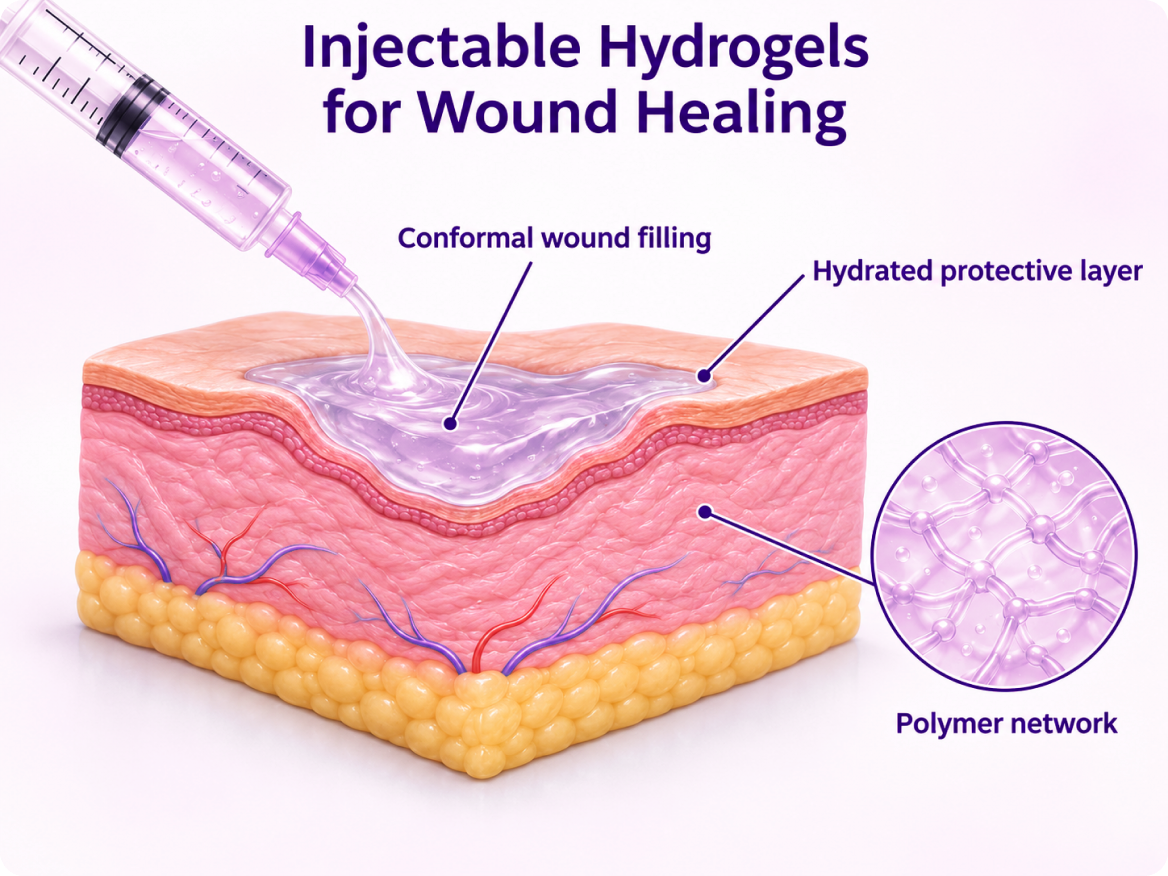
Key research priorities include:
Delivery and Handling
Investigating formulation behavior during preparation and delivery, including flow characteristics and compatibility with the intended application device.
Network Formation
Examining the conditions and timescale of network formation and how they influence handling and the properties of the resulting material.
Conformability and Tissue Contact
Assessing how flowable formulations accommodate complex geometries before network formation, and how the resulting material maintains contact under relevant test conditions.
Mechanical Behavior
Characterizing the integrity and deformation of hydrated networks under application-relevant loading conditions.
Fluid Interaction
Investigating swelling, fluid uptake and retention, and the effects of fluid exposure on material dimensions and mechanical behavior.
Biological Evaluation
Designing studies to examine material–biological interactions in relation to composition, intended contact, and application. Biological suitability is evaluated for the specific material and use context rather than inferred from its individual components.
Together, these priorities connect formulation design with the handling, physical behavior, and biological considerations relevant to further development.
Technology Focus 2 — Engineered Cryogel Scaffolds
Exploring Structure Through Macroporous Design
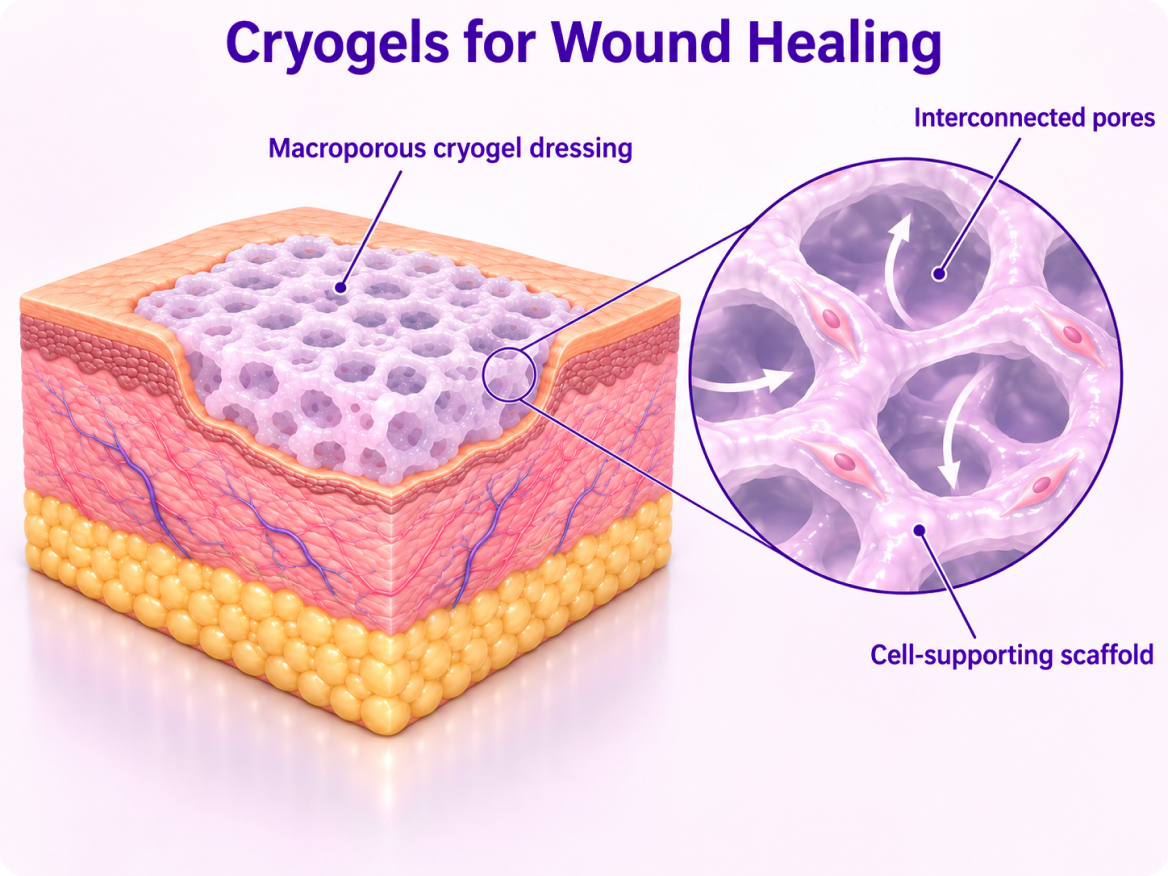
Cryogels are polymeric networks formed under partially frozen conditions. In typical cryogelation processes, solvent crystals act as porogens, leaving a macroporous structure after thawing.
This architecture provides a basis for investigating how pore size, interconnectivity, composition, and hydration influence fluid transport and mechanical behavior. These properties depend on the formulation and processing conditions; they are design variables rather than universal features of every cryogel.
At KessGen, cryogel research complements our hydrogel development by exploring how scaffold architecture can be tailored for tissue-engineering and regenerative-biomaterial research.
Our interests include the relationships among processing conditions, pore architecture, fluid interaction, and structural behavior, together with biological studies appropriate to the intended application.
Our Research Approach
From Material Design to
Application-Relevant Evidence
A biomaterial must be understood as an integrated system. Composition, processing, architecture, physical behavior, and biological interactions all inform its suitability for a particular use.
1
Define the Material-Design Question
Identify the tissue-repair challenge and the delivery, structural, and environmental requirements that will guide material development.
2
Engineer and Characterize
Investigate polymer formulations and processing conditions, then characterize network formation, structure, hydration, and mechanical behavior using methods suited to the material system.
3
Investigate Biological Interactions
Develop appropriately controlled studies to examine relevant biological responses and relate the findings to material composition and physical properties.
4
Refine for the Intended Application
Integrate physical and biological findings to guide formulation refinement and application-specific research.


Research Direction
Adaptable Materials.
Focused Scientific Questions.
Our research brings together injectable delivery, hydrated polymer networks, and material–tissue interactions. By connecting these areas, we seek to identify design principles that can inform future biomaterials for complex tissue-repair environments.